Gorge Waterfalls 50K

My recent experience with 50Ks has not been the best. Back in December I had to drop out of Deception Pass 50K because I couldn’t stop shaking at the 21 mile aid station due to the freezing, bone-soaking rain and temperature. And then there was my A race, the Scicchetrail 47K, on March 20, in the amazingly beautiful Cinque Terre.

Sciacchetrail, I’m sorry

After training for many months with a lot of intense hill workouts, my dream of finishing the tough Sciacchetrail 47K in the beautiful Cinque Terre in Italy was quickly evaporating after just a few steep hills. I just couldn’t get enough oxygen; it was as if the race was suddenly at 8,000 feet, when in reality at the steepest peak, it was never more than about 2,200 feet above sea level. Was it the jet lag or the fact that I got virtually no sleep the night before the race?

For most races I enter, I am a middle-of-the-packer, not a DFL participant, but here I was the last runner in the whole race and three sweeps with SCUPO on their bibs were right behind me and watching my every move, which was pretty easy since I was going at a snail’s pace. One of the sweeps told me I was not going to make the first cutoff at mile 15 and strongly encouraged me to drop out at the mile 10 aid station, so I did.

By the way, at the time, I thought “scupo” must translate to “sweep”. I mean, it starts with an “s” and sounds like a scooping, sweeping motion. Wrong! As I later learned when using Google Translate, scupo, in Italian, means “I’m sorry”. Okay, that is even better than sweep!

Diagnosis at Cougar Mountain

A week prior to the Gorge Waterfalls 50K, I was running at Cougar Mountain and ended up running mostly with a doctor, an anesthesiologist ultrarunner named Chris and his golden retriever. What was most interesting is when I told him what had happened at Sciacchetrail (the 50K I ran on March 20 and had to drop out of because I couldn’t get enough air; it felt like someone was sitting on my chest as I tried to ascend the first few steep hills), he told me it sounded like I had experienced an esophageal spasm. Immediately, I agreed with him and wondered why I had not realized that already.

I have had ES episodes before — last one was in January — but for some reason, did not connect the dots. That is what prevented me from completing that race. I think I have had 3 prior spasm events and everyone of them previously landed me in the emergency room. In fact, the first one had me stay overnight. Each episode, anything cardiac was ruled out but nonetheless, it feels like a heart attack (i.e., intense chest/throat pressure). So, the fact that I had to drop out of a race because I was having an esophageal spasm, makes sense. (When it happened, I had attributed it all to jet lag and lack of sleep.) The underlying cause is gastric reflux, which I have had for 15+ years, but no one knows what exactly triggers the spasm. I have never had an episode due to exercise before, however, so this was a new one, but since ES can be triggered in part by stress, it’s kind of no surprise with the jet lag, lack of sleep, etc. 

So while it gave me more clarity on what the heck happened in the Cinque Terre, it also made me more nervous that it could happen again.

Race Time

So my goal was to stay calm and relaxed and not worry too much and to get a good night’s sleep the night before the race. Amazingly, I slept well the night before, getting a good 7 hours of sleep. So far, so good.
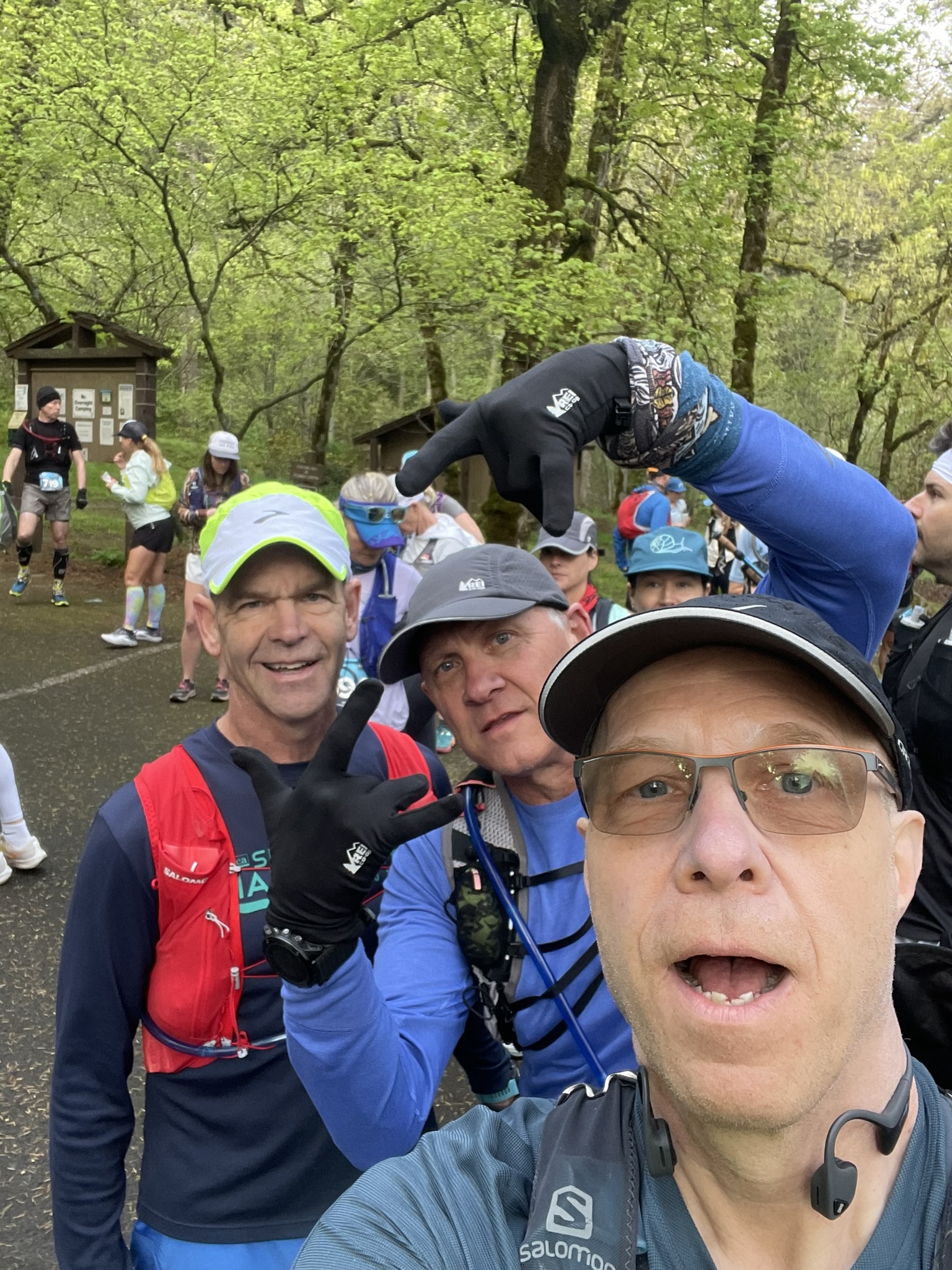
At the start with Robert and Chuck

The Gorge Waterfalls 50K race started about 15 minutes late but otherwise was fine; I was in wave 3 of 4 waves. The beginning climb was not bad at all, especially since there was no time for people to spread out before the climb started. I had my poles out but put them away cause it was too crowded and the first half mile or so was on asphalt anyway. (The poles did come in handy later at a few wet spots including a stream crossing and some hill climbs so I was happy I had them.) It was a traffic jam all the way to the top which did a good job slowing everything down and forcing me not to push too hard. Plus it was muddy in a few places. And the rocks were on the vast majority of the course from start to finish.

Matt right before he passed me at Multnomah Falls (he was in the last wave)

Towards the top, I started passing especially slow runners and that continued on the top and the downhill, easily passing 20 or so people but not taking it too fast. I ran through the first aid station at Ainsworth (mile 7.8) and then we were dumped out on about 2.5 miles of country road which were fine. After the road, there was more of the rocky trail. I was starting to get a bit tired.

At some point in the race — not sure when

At the second aid station at mile 15 at Wahclella, I was feeling at a low energy point. So I ate some chips and drank some soda and after about 5 minutes, left the aid station. The next 5 miles had a 600 ft climb to the 3rd aid station (pole time), Cascade Locks and mile 20.6. Was hanging in there, but obviously very tired. At this point, I texted my wife, Suzanna, “About 10 miles to go. Slow but sure.” I knew I would finish, which brought me a bit of joy, even through the suffering. And I put the poles away for good.

The people running the Cascade Locks all wore these black suits and looked like movie stars or celebrities of some type. This one guy who for a second reminded me of Meb Keflezighi — hey I was tired — asked me what I needed. I asked him his name — sorry I forgot it now — and he share it. Okay, it’s not Meb I thought to myself. I told him he looked so sharp and asked him “Are you the mayor of the town?” He answered “I am the mayor of the aid station” and I laughed.

Lots more rocky trail and climbing. A lot of sections were hard to run because of the rocks. In fact for the race as a whole, I thought the rocks were more significant in making it technically hard to run; more so than the 6,000 feet of elevation gain, which wasn’t exactly a picnic. Finally got to the turn-around (yay!) around mile 24-25 and then headed back.

At around mile 26 I started to feel light headed and sat down on a log, lowering my head. Was the race unravelling now? I started to doubt my ability to finish. This nice runner who I had seen many times, Geoff, caught up and asked me if I was okay. I shared that I was a bit dizzy. He offered me a GU electrolytes tablet to mix with water, which I took and either the few minutes resting or his encouragement or the electrolytes or some combo revived me. We started walking and then after a few minutes, I said to him “Can we start running again”. He says “Oh, I was walking for your benefit”. So we started running and I ran/walked with Geoff and another guy Matt into the aid station, Cascade Locks (second time) at mile 28/29.

After checking in with the mayor and refueling a bit, the three of us set out. It was about 3.2 miles to the finish and, at that point, I was very determined to get this thing done!

So we set out together and I was in the lead. After about 3/4 of a mile I turned around and Geoff and Matt were gone. Shortly thereafter, I came to the road with 1.5 miles left and I decided I would run the rest of the way and felt a surge in adrenaline and determination. 

I started running faster and quickly overtook a woman who had passed me about a mile back. I ran about 90% of the remaining course except for some brief short walks on some uphills.

With about a half mile left, we came to the town of Cascade Locks and the course changed to sidewalk. Up ahead I saw a friend from Seattle, Chuck, who had passed me last at about mile 22. We had leap frogged each other several times during the day. I started pushing it hard, overtaking Chuck and encouraging him to come along. I gritted my teeth as we entered the park and started sprinting to the finish, overtaking one more runner. I ran through the finish, throwing my hat into the air. My time might have been 8 hours and 32 minutes, but this was “sweet victory”. I had won MY race.

Robert took this video of me finishing. Thanks, Robert!

ExxonMobil’s climate predictions were spot on; too bad their message wasn’t

It has been well established that oil companies spread misinformation for decades about climate change. But many may wonder if the misinformation was an innocent oversight or if the companies intentionally spread disinformation they knew not to be true. 

Photo by Pixabay

In a study published this month in Science, the authors concluded the latter. That is, the authors found that ExxonMobil scientists knew and shared with management that human-caused climate change was real and their projections at the time (during the 1970-80s) regarding global warming accurately predicted today’s climate crisis, even though ExxonMobil’s management publicly denied it all: 

On the basis of company records, we quantitatively evaluated all available global warming projections documented by—and in many cases modeled by—Exxon and ExxonMobil Corp scientists between 1977 and 2003. We find that most of their projections accurately forecast warming that is consistent with subsequent observations. Their projections were also consistent with, and at least as skillful as, those of independent academic and government models. Exxon and ExxonMobil Corp also correctly rejected the prospect of a coming ice age, accurately predicted when human-caused global warming would first be detected, and reasonably estimated the “carbon budget” for holding warming below 2°C. On each of these points, however, the company’s public statements about climate science contradicted its own scientific data.

I encourage you to read (or at least skim) the Science article. What if ExxonMobil and other oil companies had simply shared the truth instead of hiding it and preventing real progress on climate change? One can only imagine.

Paul Litwin

A Letter to Everyone Who Has a Chance to Be Heard

This is a letter written by Greta Thunberg in 2017 or 2018, before she started her school strike for the climate; before she became famous for becoming the voice of a generation. Excerpted from Our House is on Fire: Scenes of a Family and a Planet in Crisis.

My name is Greta and I am fifteen years old. My little sister, Beata, will turn thirteen this autumn. We can’t vote in the parliamentary election even though the political issues now at stake are going to affect our whole lives in a way that can’t be compared with previous generations.

If we live to be a hundred then were going to be here well into the next century, and that sounds really strange, I know. Because when you talk about the future today, it usually means in just a few years’ time. Everything beyond the year 2050 is so distant that it doesn’t even exist in our imaginations. But by then my little sister and I–hopefully–will not even have lived half our lives. My grandfather is ninety-three and his father lived to be ninety-nine, so it’s not an impossibility that we’re going to live long lives, too.

In the years 2078 and 2080 we will celebrate our seventy-fifth birthdays. If we have children and grandchildren, perhaps they’ll celebrate those birthdays with us. Perhaps we’ll tell them what it was like when we were children. Perhaps we’ll tell them about
all of you.

Perhaps they are going to wonder why you, who had the chance to be heard, didn’t speak up. But it doesn’t have to be way. We could all start acting as if we were in the middle of the crisis we are in fact in.

You keep saying that the children are our future, and that you would do anything for them. Such things sound full of hope. If you mean what you say, then please listen to us – we don’t want your pep talks. We don’t want your presents, your package holidays, your hobbies or your unlimited options. We want you to seriously get involved in the acute sustainability crisis going on all around you. And we want you to start speaking up and telling it like it is.

From Legislation to Banking

The Inflation Reduction Act should become law by about the time you read this. And if you care about creation and climate change and haven’t had a chance to read about it: you should. It’s the biggest legislation in US history to answer what Pope Francis refers to as the “cry of the earth” and the “cry of the poor”. It’s not perfect, and many would have liked to see something closer to the original Build Back Better bill, but this bill will do a lot to reign in climate change. Many say it will reduce America’s carbon emissions by as much as 40% by 2030.

Photo by David McBee

Does this mean we can stop working on combating climate change and promoting social justice? Absolutely not. We need to keep electing and lobbying leaders who will continue to work towards both goals at the local, state, and federal level.

Another place where it’s absolutely necessary to pressure those in the position to do great things, either negatively or positively, is the world of finance. While politicians help to steer public funding, banks and investment companies are responsible for the private lending that fuels so many companies and projects. So we need to not just vote with our ballots, but also with our wallets. Yes, that means not buying products from dirty companies, but it also means redirecting your deposits and investments into institutions that are lending money to good green companies and projects promoting a better future for all. Pope Francis, in Journeying Towards Care for Our Common Home, wrote:

Promote  ethical,  responsible,  and  integral  criteria  for  investment  decision  making,  taking  care  not  to  support  companies  that  harm  human  or  social ecology or environmental ecology.

How can you act on this? First, if you have bank accounts, consider moving them to banks that promote green community investments and that steer away from fossil-fuel investments. There are a number of green websites that rate banks and help you to locate the best ones. Stop the Money Pipeline is a great resource. Recently, I did some research into green banking for the board of King County St Vincent de Paul, on which I serve — and the good news is that there are great options for local green banks as well as some online options. If you live the West Coast, Beneficial State Bank received a great rating. If you prefer credit unions and live in Washington State, check out the very green Verity Credit Union. If, on the other hand, you prefer an online bank, Aspiration is an excellent choice. Live someplace else or want to do more reading about this important subject? Check out Stop the Money Pipeline, Third Act’s Banking on Our Future page, or bank.green.

Of course, another option is to keep your deposits in one of the dirty four American banks: Chase, Bank of America, Wells Fargo, or Citibank and to give them an ultimatum. If you prefer this approach (I don’t), ThirdAct is asking you to sign the pledge and give them until December 21, 2022 to take significant action or will close your account and cut up your credit cards come January 1.

Next week, I will continue the finance discussion with more on responsible investments. Working together, we can help take care of our common home.  

Paul Litwin

We did it!

Just after putting last week’s blog post to bed, I pulled up the New York Times on my phone to read that West Virginia Senator Joe Manchin “in a Reversal, Agrees to Climate and Tax Package“. Like many, I had given up all hope that this year’s US Congress would pass any meaningful climate change legislation. And then, suddenly, there was an agreement, in principle at least, on a bill to address climate change. Yes, we still need to see this bill through votes in the senate and house and finally signed by the president, but it sounds like it is going to happen.

Photo by Markus Spiske

What changed? I don’t think it was one thing. Rather as Bill McKibben (see https://billmckibben.substack.com/zeitgeist-matters) put it:

most of all it was, I think, the widespread public scorn. Somehow it began to break through to Manchin that the only thing history would ever remember about him is that he blocked action on the worst crisis humans have ever faced. 

It was all of us, coming together, in so many ways, over so many years, and via so many forums and venues, to say “we need action, real action, on climate change, and we need it now”. It was the columns, like this one, the protests,the books, the prayers, the podcasts, the blog posts, the news articles, the votes, the voting with our wallets, the small and big changes that we have all been part of that finally made the difference. And you only have yourselves to thank!.

So let me be the first to say it: THANK YOU! We did it!

Mind you, the journey is not over. We haven’t really won. The planet isn’t quite saved. Future generations are not quite in the safe zone. But we have moved the needle in the United States a significant amount. So please, don’t stop. Don’t stop doing what you have been doing: leading by example, voting your conscience, lowering your carbon footprint, keeping your grandchildren, the poor, and future generations in mind as you pressure those in power to continue to address climate change and climate justice. Keep up the good fight.

Working together, we can help take care of our common home.  

Paul Litwin

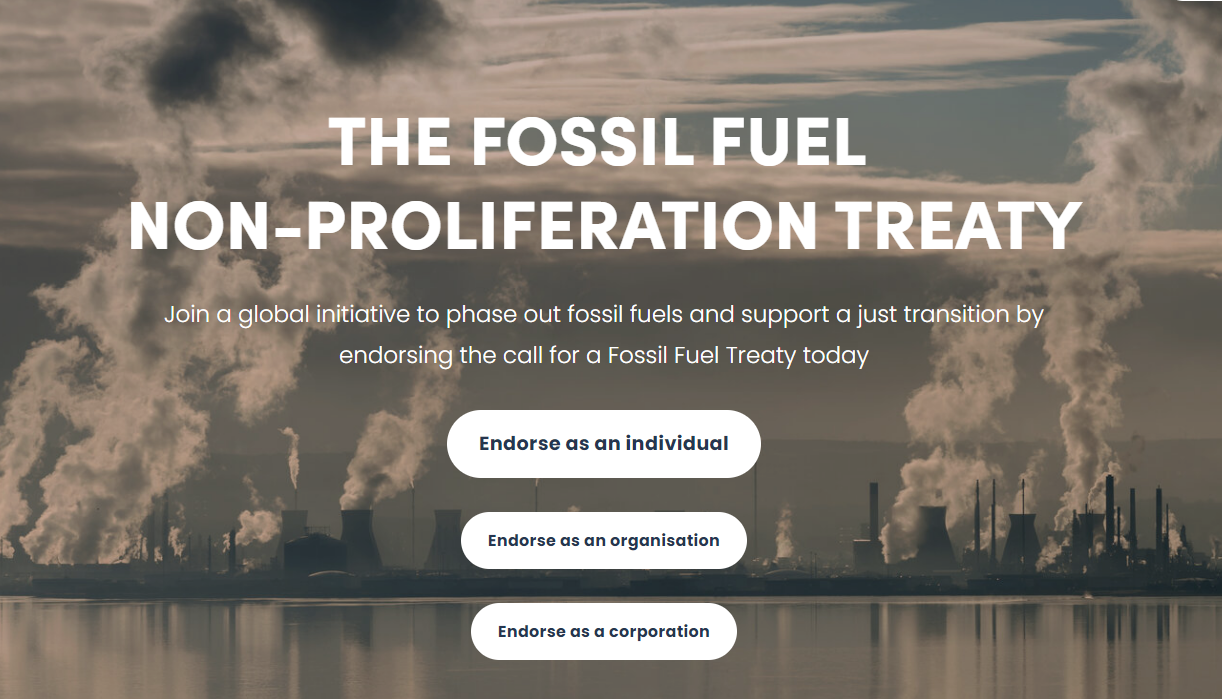
Sign the fossil fuel non-proliferation treaty

Cardinal Michael Czerny, Prefect of the Vatican’s Dicastery for Promoting Integral Human Development, has expressed support for the fossil fuel non-proliferation treaty and announced last week that all new exploration and production of oil must be phased out to prevent global temperatures from rising to a “precipice.” 

Sign the treaty!

This is why over 250,000 individuals, including Greta Thunberg, Cardinal Czerny, and me; more than 1500 organizations, including the Laudato Si Movement and 350.org; and 62 cities, including Paris, London, Geneva, and Yakima, Washington have signed the treaty. From the treaty’s website:

  • Climate change, like nuclear weapons, is a major global threat.
  • The main cause of the climate emergency is fossil fuels — responsible for 86% of all carbon dioxide emissions in the past decade.
  • Join them by endorsing the Fossil Fuel Non-Proliferation Treaty today.

Read more at fossilfueltreaty.org, sign the treaty today, and continue your efforts to wean you and your family from fossil fuels! Then spread the word to others including your elected leaders and tell them you want them to sign the treaty and to double down on their efforts to stop the proliferation of fossil fuels and climate change. 

Paul Litwin

Living on through selfless acts

I ran across a great quote in an audiobook I just finished reading – I listen to books during my long runs. The fiction book, The Flight Attendant –  by Chris Bohjalian – was a good read but hardly a book where I expected to find such a gem of a quote:

“Supposedly, whatever we do that’s selfish goes with us to the grave; whatever we do that’s selfless lives on.”

Photo by Felix Mittermeier

What a fabulous quote that cuts to the essence of the virtues of service without being preachy. It certainly forced me to ask myself “What am I doing that will live on after me; after my physical body returns to dust?” I immediately thought how living large, living with a big carbon footprint, constantly wanting and reaching for more, and regularly spending lavishly on myself is exactly the sort of thing that will accompany my lifeless body to the grave. On the other hand, if I live smaller, and work harder to minimize my carbon footprint while maximizing my service to others, there will be much to live on after me; after my body returns to dust.

The worst devastation caused by climate change will happen after we are gone. What better way is there to ensure a piece of ourselves continues to live on after our souls have moved onto the afterlife than to work on climate action and justice today.

Working together, we can help take care of our common home.  

Paul Litwin

Plastic Free July

Millions of people around the world are participating in “Plastic Free July” that starts on Friday, July 1. You might say “I can’t go plastic free” and I would answer “Nor can I!” but the idea behind Plastic Free July is to move us all in the right direction in reducing our use of plastic, especially single-use plastics.

Why? What is so bad about plastic? Well, first there is the carbon footprint of manufacturing plastic; hint: it comes from fossil fuels! And, unfortunately despite what you might have heard, most (around 90%) of the plastic we use either isn’t recycled or can’t be recycled, and even when it can be recycled, remember that recycling itself exacts a carbon footprint, not to mention its impact on the poor and marginalized. Then there is the fact that plastic pollution is a huge problem on land, in the sea, our water and food supply, and in our bodies!

So how does one go about reducing their use of plastic? Start by taking an accounting of the plastic in your home and office. Walk through each room of your house and note what items are made of or housed in plastic. Then start reducing those plastics, especially single-use plastics, one by one. 

Ideas for reducing plastic usage:

  • Refuse to purchase single-use water bottles. Carry a metal or glass water bottle with you when you are away from home.
  • Say no to straws. (Seattle has banned plastic straws, but remember to stay vigilant when traveling elsewhere.)
  • Stop using paper cups (usually lined and topped with plastic) at your coffee shop. Bring your own steel coffee mug to your espresso stand and to work. 
  • Bring metal flatware and reusable dishes to work so you can avoid single-use plastics.
  • When purchasing food, look for items in glass bottles, cardboard boxes, or metal cans (those not lined in BPA plastic). As much as possible, purchase bulk items in reusable containers and store them in glass jars.
  • Purchase cloth shopping and produce bags. We use organiccottonmart.com. 
  • Get rid of vinyl shower curtains, pillow, and mattress covers and replace them with natural fabrics.
  • Consider replacing your foam mattress with a natural cotton mattress.
  • Replace plastic food storage containers with glass (even with plastic lids, they are better), metal tins, or reusable alternatives to plastic wrap such as etee (shopetee.com).
  • Purchase cosmetics and other bathroom supplies in non-plastic containers. Buy bar soap rather than liquid soap in plastic bottles.
  • When purchasing appliances look for ones that have minimal or no plastic.
  • Download the Detox Me app on your phone to get more suggestions on reducing your exposure to plastics and other toxins. See tinyurl.com/lsia-detox-me.

You can download a Plastic Free July calendar with ideas for each day of the month from at tinyurl.com/plastic-free-cal-2022. And check out the plasticfreejuly.org website to learn more about plastic, plastic pollution, and lots of additional ideas on how to reduce your use of plastic! 

Working together, we can help take care of our common home.  
Paul Litwin

Thinking about Dad

On Father’s Day, I was thinking about my dad. My father died nine years ago. Dad was a good Catholic and a political conservative. Our politics did not align very often, but while we might take opposing viewpoints on whether to be tough on crime, raise taxes, lobby for the latest nuclear power plant, and many other topics, my dad also taught me to conserve resources, to reuse, recycle, and always take care of creation. And don’t ever let him see you throw a recyclable item in the garbage!

My dad was also a believer in science. He would not understand those who believe facts are a matter of opinion; to be manipulated “for the cause”. He would favor the positions of scientists over politicians. While my father loved big business, he also loved parks, animals, plants, and nature. I think he would agree it was time to come together to tackle climate change and take care of our planet, rather than be contrary just to stop the other side from gaining an inch. I am pretty sure he would put God’s creation and his grandchildren and great grandchildren ahead of zero sum politics.

In Fratelli Tutti, Pope Francis writes:

The development of a global community of fraternity based on the practice of social friendship on the part of peoples and nations calls for a better kind of politics, one truly at the service of the common good. Sadly, politics today often takes forms that hinder progress towards a different world.

I miss my dad. And I miss a society where all political sides worked together more often than not. It is only in working together that we can truly take care of our common home. 

Paul Litwin

Don’t flush away the forests

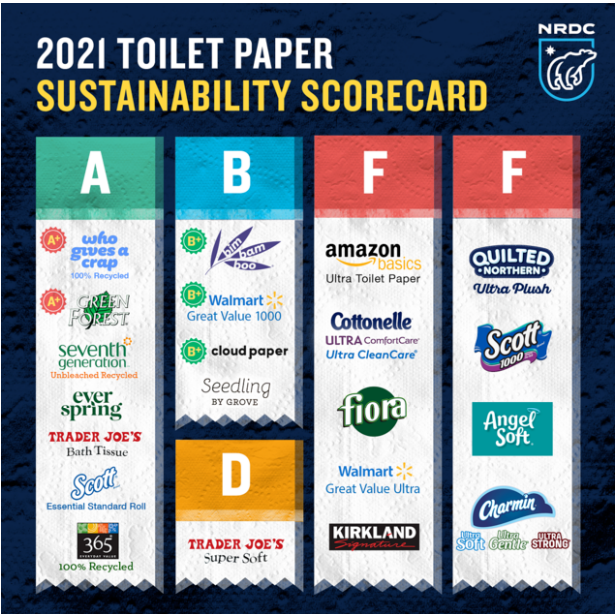
The National Resources Defense Council recently published the third edition of their Buyer’s Guide to the Sustainability of At-Home Tissue Products. Using the NRDC’s report, you can quickly assess the environmental impact of your  toilet paper, paper towel, and facial tissue products and change to more earth-friendly tissue purchases for your household.

NRDC Toilet Paper Scorecard

You can find the article at tinyurl.com/issue-tissue and the scorecard at tinyurl.com/tissue-score. Using the scorecard you will find that many mainstream products such as Cottonelle, Quilted Northern, Amazon Basics, Charmin, Angel Soft, Fiora, and Costco Kirkland brand received grades of F while other tissue products from companies Green Forest, Who Gives a Crap (I am not making that name up), Seventh Generation, Trader Joe’s Bath Tissue (not the Super Soft product which received a D rating), Whole Foods 365 brand, and others scored A or A+. 

At the bottom of the scorecard, you will also clearly see that a lot of thought went into the methodology used to compare tree-based, recycled, and bamboo based products. So check out the scorecard to easily improve your sustainability score in the tissue arena and stop flushing and throwing away our forests.

Note: I found out about the NRDC Scorecard using the Climate Action Now app, which I mentioned in a prior post. Highly recommended!

Working together, we can help take care of our common home. 

Paul Litwin